If you were at the festival, you probably heard it a dozen times from the stage. But we’ll say it again: You’re a beautiful audience and we love you. The dancers, the singers, the shouters, the moshers, the ravers, the groovers. You’re the greatest.



more than you'll ever know
If you were at the festival, you probably heard it a dozen times from the stage. But we’ll say it again: You’re a beautiful audience and we love you. The dancers, the singers, the shouters, the moshers, the ravers, the groovers. You’re the greatest.
We’re a bit cynical when it comes to performing DJs. We tend to think that there’s not much to actually “performing,” since the DJ could conceivably just make a long file and then pretend to be mixing and switching as gestures to the audience. Major Lazer, the collective dance music project headed by internationally famous producer Diplo, doesn’t bother with the conceit when they play live. Though there is a guy behind the boards (Diplo? Not really clear), the music is accompanied by all sorts of performative nonsense—streamers, giant plastic globes, pyrotechnics, dancing girls—that pretty much set the stage for what their concerts are—just a huge party. And the audience was only too willing to participate.

And it was a kind of crude, regressive party, which may be the best kind and copacetic to the hip-hop value set. The dancing girls, for instance, were obviously at the beck and call of the male hosts, who made no bones (no pun intended) about using them for their own pleasure. At one point they called on everyone to take off their shirts, and when very few people obliged they had to moderate the request by asking people to just grab something to throw in the air. As parties go, it was a makeshift affair.

But an effective one. When they said “jump,” everybody jumped. When they said “crouch down on the ground,” everybody crouched. It was nasty in the best sense, and once Bjork’s show was over, that party joined this one. People are very adjustable.

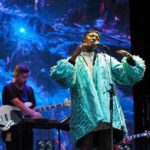

Lorde’s talents speak for themselves, but only her youth explains her performance on the Green Stage under a suitably dramatic parting of dusk clouds. Spinning and cantering in a long see-through lace skirt and white Adidases, the New Zealand singer-songwriter took full advantage of her burgeoning fame as the voice of female millennials. But she was also site-specific. After her first song she explained that she’d played the Red Marquee back in 2014, when she was still a teen, and couldn’t believe she’d been promoted to the main stage, and as the opener for Bjork! (Actually, she didn’t mention Bjork, but the significance is obvious)

Prefacing each song with a small explanation of its meaning, Lorde seemed oblivious to the fact that a substantial portion of the people she was talking to had no idea what she was saying, and we’re not just talking about the Japanese listeners. We understood it more when she explained she was a witch and that playing in front of a mountain had special meaning. We weren’t entirely sure what she was talking about when she went on about having crushes as an even younger person. We mean, we understood, but didn’t really care. It is a youth thing, and if the young female Japanese members of the audience did care about such things, we’re not sure they absorbed her specific take on it.

But she kept saying how “honored” she was to be here, and that such a “loving” festival could only happen in Japan. Apparently, she had toured the grounds during the day, incognito in a surgical mask, and was impressed with everything. She gave back with a singularly heartfelt performance that was all about her. Her musicians practically vanished in the glow of her self-regard, and we’re fine with that. Lorde wouldn’t be the artist she is without that self-regard. But we have a feeling that ten years from now she’ll hit herself on the forehead when she remembers this concert and say, “What was I thinking?” (Text: Philip Brasor; photos: Mark Thompson)


It wasn’t surprising that Sturgill Simpson’s set at the Field of Heaven in the late afternoon was sparsely attended. Country music doesn’t get a lot of attention in Japan except from diehards, and Fuji Rock is, basically, a rock festival. However, Simpson is not purely a country artist, though he’s go the classic drawl and the sad sack subject matter that have made him one of the more interesting left field country artists in America right now. But he’s also a mean guitar player who’s obviously studied Clapton, Page, Van Halen and other blues based shredders, and he shapes his songs around solos and big instrumental moments.

If more people knew about this aspect of Simpson’s music, they probably would have showed up. Moreover, if they knew that Simpson once lived in Japan when he was with the US Navy, they might have been more curious. He word a Hakama jacket in deference to Japan, but he was too shy to make a big deal out of his time here. He dedicated “Sea Stories” to Japan, a song about drinking in the country mode, but here the drinking is in places like Roppongi, Harajuku, Shibuya, etc. The crowd picked up on every reference and cheered each one. Who says country music doesn’t travel.
But what really hooked the crowd was the rock dynamic of what we consider the best-looking group at the festival so far: an organist who looks like John Kaye’s evil twin, a mountain of a bass player, and a drummer who was probably the ne’er-do-well son of a backwoods gas station monopoly. They shifted capably from backwoods country to electric blues to classic rock with the facility of a great bar band, and the audience was sucked in.
Country, yes, but it was also the best pure rock show of the weekend.
(Text: Philip Brasor; photos: Mark Thompson)
By now, we’re pretty anxious whenever we step into the Red Marquee. Though the rain has mostly held off today, as soon as we entered the tent to wait around for the British shoegazer outfit Slowdive, it did start to rain in earnest, and we wondered it we were the cause. Actually halfway through the set we noticed some sunshine outside, but maybe that was our imagination, or a mirage. But in any case the rain seemed to have stopped.

Who knows? Maybe the band’s hypnotic psychedelic guitar sound appeased the weather gods. For sure, their music is not the kind of thing we listen to at home. It’s too redundant, the tempos are all the same, and there’s no dynamic range—songs start incredibly loud and remain that way. The only distinctions are melodic and harmonic.

But live, this stuff works much better than you could imagine, and while some of the people definitely stopped by to get in out of the rain, by the end of the set, they were as hypnotized as those who expected to be. I mean, any band with three guitars has to be paid attention to.

At one point, Neil Halstead commented about Japan, “I really like that the weather doesn’t change here,” though maybe he was talking about the weather inside the Red Marquee. God knows it changed three times during their set outside.

(Text: Philip Brasor; photos: Mark Thompson)
Shugo Tokumaru is pretty much the standard bearer for that quirky brand of Japanese indie rock, and has been for a while. He’s become so good at it that he has no problem tempting ridicule with overly cute touches. There were lots of interesting things on the White Stage before he came out, including mechanical dolls.
The cuteness works not as cuteness but as something with meaning in an entertainment sense. Tokumaru is no longer a boy, but he still understands what impressed him when he was young and he tries to impart that wonder to his audience. During his afternoon set, when there was a lull in the precipitation, he explained that although Mount Fuji is far away, Fuji Rock Festival can still celebrate a great Japanese mountain, except that it’s Mt. Naeba.
This imaginative and optimistic grasp of the world extends to the music, which is happy without being saccharine, quirky without being precious. Time and key signatures are as malleable as Tokumaru’s imagination, and he’s go the band to make it happen. Everyone except the drummer and the bass player double and triple on various instruments. The woman who was mostly on the accordion picked up the electric guitar for one song and stood on platform to shred, the keyboard player fanning her with a big board to make her hair blow like a real rock star.
Tokumaru also brought out Maywa Denki, the two-man performance group whose schtick is inventions for every situation, in this case an electrical percussion instrument that Maywa’s president word like a set of wings. He added beats to a great Latin tune and it made perfect sense. As did the bluegrass interlude in another song (Tokumaru is a great guitarist), and the crude AV touches, like streamers that came out during the climax of another song, a did the whistling and mouth percussion that formed the “solo” in another song.
In Tokumaru’s world, everything works because it works in his head. That he allows us entry is a privilege.
(Text: Philip Brasor)
The Sunday openers are usually a very different breed of musician than those who start up Friday or even Saturday. Those people are supposed to jump start the audience, but the Sunday acts tend to be more soothing, since more likely than not anyone who manages to drag themselves out of their tents before noon is feeling the previous night’s excesses. So it was only proper that Canadian singer-songwriter Ron Sexsmith, who seems to play Fuji every two years or so, took the Green Stage with his gentle songs of love and pain. Self-deprecating to the point of ridiculousness (“Here’s one you may know…or maybe not”), he was dressed in a spiffy checked sport coat and a straw fedora, his characteristically boyish features filled out considerably in middle age. He speaking voice is indistinguishable from the one he uses to sing: lilting and a little shy. When he occasionally breaks out in a solo on his acoustic guitar, you surprised he has that much fight in him.

Sexsmith dedicated the set to a woman who worked for Smash but apparently doesn’t any more. We’d hate to think she might have died, but it was difficult to tell in Sexsmith’s dedication, which didn’t seem particularly sad. He has lots of fans in Japan, despite the language barrier, and when we went close to the stage we saw a lot of them swaying to his lovely little melodies and mouthing the works. Most were couples. It’s the kind to music that seems to appeal to people who are happy in love, rather than those who aren’t, and when he left the stage after a strong 50 minutes, he received a heartfelt ovation that belied the tiny crowd. He’ll be back.

The White Stage had a relatively laid back opener as well. Real Estate, the New Jersey band who plays a satisfyingly redundant, slightly hazy take on guitar pop was the perfect band to ease the crowd into a Sunday that threatened to be as wet as Saturday, but toward the end of the set the drizzle let up and there was even a few patches of blue. Martin Courtney has one of those high, very white voices that wouldn’t hurt a fly even if he were reciting Danzig lyrics, and combined with the group’s infectious sense of melody, the audience, which almost filled the White Stage area, fell right into their mid-tempo rhythms. It was better than aspirin, and easier to take.
Though as the crow flies, Siberia isn’t that far from Japan, in terms of making it from there to here as a DJ, Naeba might as well be on the moon. But there was producer Nina Kraviz taking the Red Marquee at 2 in the morning for an emotionally rich, often gorgeous 90 minutes of electronic music. Apparently, Kraviz got into the game in a decidedly unsual way—she actually studied to be a DJ-producer at the Red Bull Academy, after moving from Irkutsk to Moscow, where she formally studied dentistry but mainly fell into the city’s dance music scene. At the Red Marquee she didn’t sing, which she often does on her records, but the music was lyrical anyway—open-hearted even. We wouldn’t call it happy music, like The Avalanches show earlier in the day, but it put us at ease. You danced because it felt good. You couldn’t resist.
The Avalanches were supposed to appear at last year’s festival but cancelled at the last minute, so their showing up this year was a big deal, and Smash made sure they were situated prominently on the Green Stage in the middle of Saturday afternoon, traditionally the busiest day of the event. Unfortunately, this year it was also the wettest day of the event, and while the Green Stage was well attended, there was a soppy, drenched quality to the proceedings.

There was also mystery, and thus some surprise. Given that the two album released by the group—16 year apart, no less—are sample driven and derived, no one know exactly what to expect from the “act,” and thus it was interesting to see six people run out on stage. Of course, the two core members of the band, producer Robbie Chater and multi-instrumentalist Tony Di Blasi—were first and foremost. But who was this female drummer and this rapper and this stylish front woman/female vocalist? Apparently, they are simply the current touring incarnation of The Avalanches.

After that, the crowd could hardly care, because they played all the hits, only in a live group format, with Eliza Wolfgramm handling all the female vocals and Spank Rock handling all the rapping. Though there was some differentiation between the original versions (derived from genuine 45s) and those produced by this lineup, the audience didn’t seem to mind because the show was propulsive and positive. They knew that people were here to dance, regadless of the weather, and they satisfied that desire to the fullest. Occasionally, Wolfgramm’s interpretation faile the original, like on the sample for “Guns of Brixton” and the seminal single “Because I’m Me,” fell short of the original, but the rest of the band make up for the distinction with a rocking beat and a devil-may-care attitude. Though it wasn’t as inspired as the Gorrilaz show the night before, it was just as beatastic.

“Thank you for coming to see us in the rain,” Wolfgramm said at the end of the show, glowing with gratitude. These people, she should understand, know how to party.
(Text: Philip Brasor; photos: Mark Thompson)
