[wpvideo tnL4MBML]
Boardwalk breeze
more than you'll ever know
[wpvideo tnL4MBML]
Boardwalk breeze
Reduced to three members, the math rock band Battles still refuses to call it a day. As a matter of fact, they seem to be thriving after the departure of founder Tyondai Braxton. Which isn’t to say they’re the same band, only that they’ve adjusted admirably.
They’ve also thrived. Dave Konopka, the group’s bassist commented halfway through their headliner gig at the White Stage Sunday night that they never expected any such “honor,” but in any case, just being able to play Fuji at all was a privilege.

At first, there weren’t that many people there, owing to the fact that their starting time coincided with the end of the Chili Peppers’ show. But as they added to their sound, gradually and eventually they presented their beat-heavy, angular rock style, people showed up, stayed, and rocked out accordingly.

It wasn’t necessarily easy to do. Battles’ music is tricky to the point of confounding. Generally, founder Ian Williams starts the process with a guitar or keyboard loop, and then Konopka adds to it with some bottom and top (he also plays guiitar). But as sonn as drummer John Stanier shows up ad starts pounding away, all bets are off. First of all, Stanier is such an imposing physical presence that the audience can’t help but sit up and take notice. He sits center stage, not in the back, pounding away for all to see.

Since it’s difficult to say where one Battles song ends and another begins, we can’t quite put our finger on anything that might be considered definitive. Nevertheless, since Tyodai left, there some openings, at least in the shipping dept. Who knows? It may end up being the perfect job. (text: Philip Brasor; photos: Mark Thompson)

Competing with both Babymetal and the Red Hot Chili Peppers is no mean feat, but, then again, saxophonist Kamasi Washington isn’t going to be particularly concerned with that since he’s a jazz musician who probably doesn’t think he’s up against anyone else but himself.

For sure, the crowd at the Field of Heaven for his Sunday night headlining show was sparser than normal, but the folks who showed up were treated to a monumental show of musicianship that didn’t stint on the spectacle. Washington, after all, has been instrumental in imbuing hip-hop with a potent jazz component, and he has taken back in equal amounts: the show at the Field of Heaven was dance delirium.

The large group didn’t really play that many songs, but everything was fortified with rhythmic intensity thanks to two drummers and an aesthetic that took black urban music for granted. “Rerun,” a typical R&B jam gradually evolved into a showcase for every soloist on the stage, including the seemingly teenage pianist. “My Hero,” a song dedicated to Washington’s grandmother that feature his own father on flute, churned into an emotional epiphany that left the crowd drained and wanting more.

Even the showcases for band members–the bassist who just released a solo album, the two drummers who were given a spotlight to challenge each other, the keyboardist known as “Mr. Boogie”–were expanded to include everyone on stage, and also everyone at once. The songs built into monumental things, and the audience, in addition to dancing their asses off, were compelled to absorb the musicianship, which was astounding and thrilling at the same time.

The band dug it. They provided an encore because the response was so overwhelming This wasn’t necessarily a crowd who were jazz aficionados. They like R&B, and can appreciate a good dance tune. But Kamasi gave them so much more: dancing that transcended mere bumping and grinding. They were transported. (text: Philip Brasor; photos: Mark Thompson)

[vimeo 175984501 w=500 h=281]
Never heard of Smart Soul Connection? Think Peter Sellers meets the blues in a Showa Era lounge. Lyrics often amounted to just one word – SPYS! – shouted at the appropriate intervals.
For the finale, the singer jumped into the crowd and spread the gospel of the blues harp. We say Amen to that.
We didn’t know that Beck was schedule to play the first Fuji Rock Festival in 1997. We assume that he was on the doomed second day, which was cancelled due to a typhoon. In any case, he mentioned this fact near the beginning of his headlining show at the Green Stage Saturday night, a fully pop showcase of the artist’s career highs, a greatest hits show if there ever was one. Naturally, the audience loved it, but what did it say about Beck’s legacy as an alternative artist?

He almost threw away the first three songs, as if he wanted to get them over with: “Devil’s Haircut,” “Black Tambourine,” and “Loser,” that latter a song that become so iconic that when the audience dutifully chanted the chorus in accordance with Beck’s wishes–“I’m a lost baby, so why don’t you kill me”–you couldn’t decide if you should choke up or be depressed.

Part of the problem is the way he assumed the guise of a superstar; dressed mostly in black, with a polka-dot shirt, Beatle boots, and black fedora, his pimp-like aura emphasized his regret at having not been born a black man. The blues and soul tropes he appropriated so freely in his career were showcased openly during his set. Though “Sea Change” and “Morning Phase” are the albums that garnered the bulk of praise for their quiet, contemplative mood, “Midnite Vultures,” his ode to black music, was the album he referenced the most this time. His gospel chops were whiter than Wonder Bread, but they were also thrilling.

And despite the awkward attempts at “authenticity” it worked, mainly because he was so sincere in his desire to both entertain and make a connection with an audience he obviously cherished. At the end of the set, during “Two Turntables and a Microphone,” he sat down (after having conspicuously changed into an ensemble that exchanged the monochrome cast of his previous clothing into something patterned on red) and discussed his relationship with Japan, as if it were something we really cared about. We don’t think anybody did, but the fact that he went out of his way to express that, “If I could, I’d just like to sit here and have a conversation with all of you.” Actually, that’s what the whole concert way: a conversation that everyone got. Nobody wanted him to be anyone except who he was, regardless of his own insecurities. (text: Philip Brasor; photos: Mark Thompson)

WilcoBeefy, behatted, and beaming, Wilco leader Jeff Tweedy took the Green Stage at sunset on a cool, green evening. Throughout the band’s 90-minute set he seemed at once at peace and energized. As usual, he didn’t say much beyond the usual thank yous, but he repeatedly tipped his hat to the audience and at one point offered up the opinion that “it doesn’t get any better than this.”
The feeling was mutual. Wilco is one of those rare bands who can’t do wrong because their approach is quality: if you can’t make something fantastic, then don’t do anything at all.

At the end of “I’m Trying to Break Your Heart,” he muttered “goodbye” and tipped his hat, as if in recognition to the audience’s attention. In the monumental “Via Chicago,” one of those characteristic Wilco songs that combine anodyne musical sentiments with discordant bipolar dissonance, he seemed resigned to the song’s hard rock prerogatives. The audience, who knew the song instinctually, raved when drummer Glenn Ktche freaked out in his normal way. The light was brighter. The world was livelier.

It was a mellower set than the one they did at the White Stage some ten years ago, and yet more intense, owing perhaps to Tweedy’s disposition to make sure this audience was thoroughly incorporated into the Wilco aesthetic. In the tougher number, Nels Cline showed off his particularly classical lead guitar skills. The freakouts were fully appreciated. Is Wilco the Grateful Dead’s successor as the greatest American band?
With his battered jacket and Big Bill Broonzy t-shirt, Tweedy was the ultimate alt-rock dork, but there was nothing precious about the performance. Whatever his demons, Tweedy seemed happy to be here, and we were extemely happy to have him. He honored the setting and the circumstances with great, transporting music. (text: Philip Brasor; photos: Mark Thompson)

Continuing with the funk/R&B theme over at the east end of the festival, Con Brio tried to top their extraordinary performance at the prefest party on Thursday night, and came pretty damn close. The crowd at the Field of Heaven wasn’t quite as stoked as the crowd at the Red Marquee, but it’s difficult to compare. The prefest party is all about anticipation. During the festival itself you have to prove yourself, and they did.
Lead singer Ziek McCarter was in his best Michael Jackson mood, spinning and sashaying and bumping and grinding and whooping to beat the band, which is difficult to do in this case since the band is so intensely funky. Thanks to a particularly loud and energetic sound check, a lot of people sauntering by from the Orange Cafe and Cafe de Paris decided to stick around, and they were quite satisfied. From the very first notes, the crowd was pumping and dancing.

There was also a lot more jamming than there was at the Red Marquee, which is appropriate for the Field of Heaven, which was baptized by Phish in 1999. During “When the Sun Goes Down,” not only did McCarter get the crowd clapping louder than anytime I’ve heard in recent years, but every member took an extended solo. (Personally, we could have done with the synth solo) The atmosphere became so intense, security started asking people sitting down to get up and remove their chairs. There were thinking about the people who wanted to squeeze in and boogie, but, by rights, those people should not have been sitting down during such a show in the first place.
“This is the most beautiful place we’ve ever played,” McCarter said at one point, echoing more than one act we’ve seen during this festival alone. Their enthusiasm matched the hyperbole.

Since they’re from San Francisco, Con Brio’s version of JB’s “It’s a Man’s World” was reconfigured as “It’s a Woman’s World,” a slight blasphemy that we let slide. No such transgression was evident from The Heavy, the estimable hard R&B band from England, who was making their second appearance at Fuji Rock, and leader Kelvin Swaby made it a point to say that every chance he got.
After the requisite, “this is the greatest fucking festival in the world,” Swaby repeatedly propped for the band’s new album, asking the crowd, somewhat ingenuously if they wanted to hear songs from it, as if they had a choice. In any case, they complied, even when Swaby kept instructing them how to singalong or react to certain lyrics in songs.

“When I say ‘cut it,’ go crazy,” he commanded, and people went crazy in their own fashion during the funk workout. During a Springsteeny R&B number, the crowd was asked to repeat certain lines, which they did. Gotta love the Japanese fan.
For what it’s worth, the show picked up a sizable crowd as the set progressed and the sun started setting in the west. It was a beautiful scene and the music eventually justified all the fussiness. Funk is like that. (text: Philip Brasor; photos: Mark Thompson)

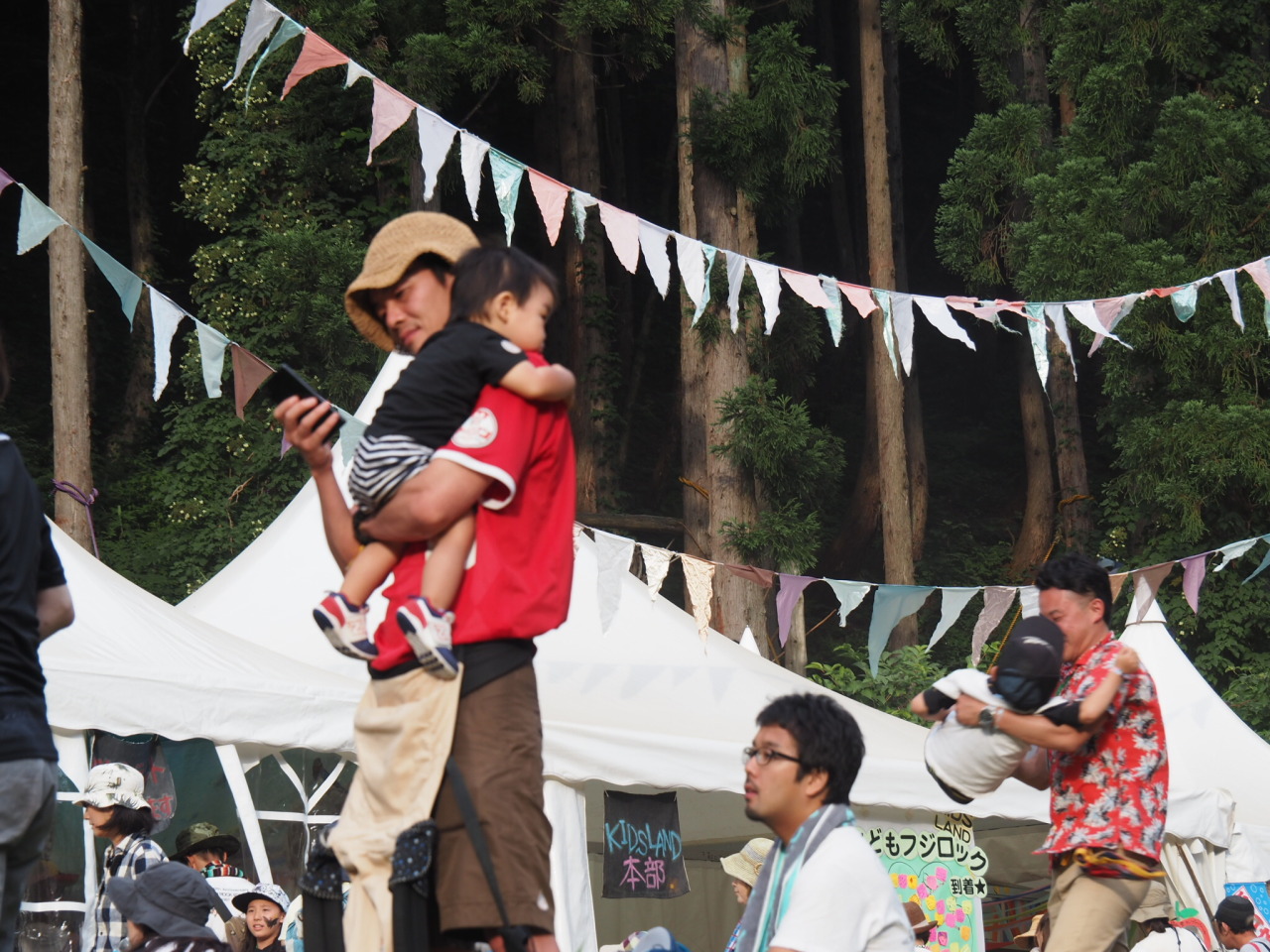
Father’s Day at kids’ land. Rock on mamas! (photo: Mark Thompson)
People will tell you that the Japanese can’t do funky. Obviously, that’s a stereotype that’s been around too long. At the very least, Japanese are no less funky than white people, which may not be saying much, but if you hear someone say “Japanese folk just ain’t got the funk!”, play them some Zainichi Funk.

“Zainichi” means “resident in Japan, and Zainichi Funk’s music takes Japanese themes and motifs and funkifies them. Understanding the above–mentioned prejudice, however, they have fun with the concept. Leader Kenta Hamano, for instance, has all the JB moves down, but he doesn’t make any sort of claim to doing them well. His splits and dance steps are more like JL (Jerry Lewis) than JB, but he also adds stuff that’s completely his own, like this stuttery thing on tip toes. And while his singing isn’t going to give Bobby Byrd anything to worry about, he commands a charming vibrato that adds a bit of sassiness to his delivery. And we love his strawberry sherbet suit. He also does his patter in purposely bad English. "So, you wanna call and response?” he yelled. “Let’s call-and-response.” He then gave the audience an almost impossible tongue twister.

Jokes aside, though, the band is tough. During their afternoon set on the White Stage they sampled every brand of funk, from JB’s “Super Bad,” to funkified versions of kayokyoku (traditional Japanese pop). One song, a smooth R&B jamm called “Kyoto” trotted out all the Japanese streotypes in another call-and-response gambit. “Pokemon,” “Nintendo,” “ninja,” etc. The audience loved it at by the end of the 45-minute set the crowd had overflowed the borders of the venue. They know who’s got the funk. (text: Philip Brasor; photos: Mark Thompson)

We were a little late to the Disclosure show at the White Stage and by the time we arrived the party was going full blast, the area one would normally call the mosh pit a churning mass of humanity.

It was just the Lawrence brothers on stage, sans high-profile vocalists, who were represented by recordings, so most of the action was in the audience. Disclosure’s frantic, bass-heavy, poppy dubstep almost never lets up, but the crowd didn’t seem to require a break, at least not while we were watching. When they launched into “Carnival,” you could finally understand the title. It was a song made for this kind of huge, unhinged crowd.

In the end, vocalists would just have been an unnecessary distraction. It was certainly the biggest dance party we’d seen at the White Stage in a long time. We’re tired just thinking about it. (text: Philip Brasor; photos: Mark Thompson)