Wilco

WilcoBeefy, behatted, and beaming, Wilco leader Jeff Tweedy took the Green Stage at sunset on a cool, green evening. Throughout the band’s 90-minute set he seemed at once at peace and energized. As usual, he didn’t say much beyond the usual thank yous, but he repeatedly tipped his hat to the audience and at one point offered up the opinion that “it doesn’t get any better than this.”

The feeling was mutual. Wilco is one of those rare bands who can’t do wrong because their approach is quality: if you can’t make something fantastic, then don’t do anything at all.

image

At the end of “I’m Trying to Break Your Heart,” he muttered “goodbye” and tipped his hat, as if in recognition to the audience’s attention. In the monumental “Via Chicago,” one of those characteristic Wilco songs that combine anodyne musical sentiments with discordant bipolar dissonance, he seemed resigned to the song’s hard rock prerogatives. The audience, who knew the song instinctually, raved when drummer Glenn Ktche freaked out in his normal way. The light was brighter. The world was livelier.

image

It was a mellower set than the one they did at the White Stage some ten years ago, and yet more intense, owing perhaps to Tweedy’s disposition to make sure this audience was thoroughly incorporated into the Wilco aesthetic. In the tougher number, Nels Cline showed off his particularly classical lead guitar skills. The freakouts were fully appreciated. Is Wilco the Grateful Dead’s successor as the greatest American band?

With his battered jacket and Big Bill Broonzy t-shirt, Tweedy was the ultimate alt-rock dork, but there was nothing precious about the performance. Whatever his demons, Tweedy seemed happy to be here, and we were extemely happy to have him. He honored the setting and the circumstances with great, transporting music. (text: Philip Brasor; photos: Mark Thompson)

image

Con Brio/The Heavy

Continuing with the funk/R&B theme over at the east end of the festival, Con Brio tried to top their extraordinary performance at the prefest party on Thursday night, and came pretty damn close. The crowd at the Field of Heaven wasn’t quite as stoked as the crowd at the Red Marquee, but it’s difficult to compare. The prefest party is all about anticipation. During the festival itself you have to prove yourself, and they did.

Lead singer Ziek McCarter was in his best Michael Jackson mood, spinning and sashaying and bumping and grinding and whooping to beat the band, which is difficult to do in this case since the band is so intensely funky. Thanks to a particularly loud and energetic sound check, a lot of people sauntering by from the Orange Cafe and Cafe de Paris decided to stick around, and they were quite satisfied. From the very first notes, the crowd was pumping and dancing.

image

There was also a lot more jamming than there was at the Red Marquee, which is appropriate for the Field of Heaven, which was baptized by Phish in 1999. During “When the Sun Goes Down,” not only did McCarter get the crowd clapping louder than anytime I’ve heard in recent years, but every member took an extended solo. (Personally, we could have done with the synth solo) The atmosphere became so intense, security started asking people sitting down to get up and remove their chairs. There were thinking about the people who wanted to squeeze in and boogie, but, by rights, those people should not have been sitting down during such a show in the first place.

“This is the most beautiful place we’ve ever played,” McCarter said at one point, echoing more than one act we’ve seen during this festival alone. Their enthusiasm matched the hyperbole.

image

Since they’re from San Francisco, Con Brio’s version of JB’s “It’s a Man’s World” was reconfigured as “It’s a Woman’s World,” a slight blasphemy that we let slide. No such transgression was evident from The Heavy, the estimable hard R&B band from England, who was making their second appearance at Fuji Rock, and leader Kelvin Swaby made it a point to say that every chance he got. 

After the requisite, “this is the greatest fucking festival in the world,” Swaby repeatedly propped for the band’s new album, asking the crowd, somewhat ingenuously if they wanted to hear songs from it, as if they had a choice. In any case, they complied, even when Swaby kept instructing them how to singalong or react to certain lyrics in songs. 

image

“When I say ‘cut it,’ go crazy,” he commanded, and people went crazy in their own fashion during the funk workout. During a Springsteeny R&B number, the crowd was asked to repeat certain lines, which they did. Gotta love the Japanese fan.

For what it’s worth, the show picked up a sizable crowd as the set progressed and the sun started setting in the west. It was a beautiful scene and the music eventually justified all the fussiness. Funk is like that. (text: Philip Brasor; photos: Mark Thompson)

image

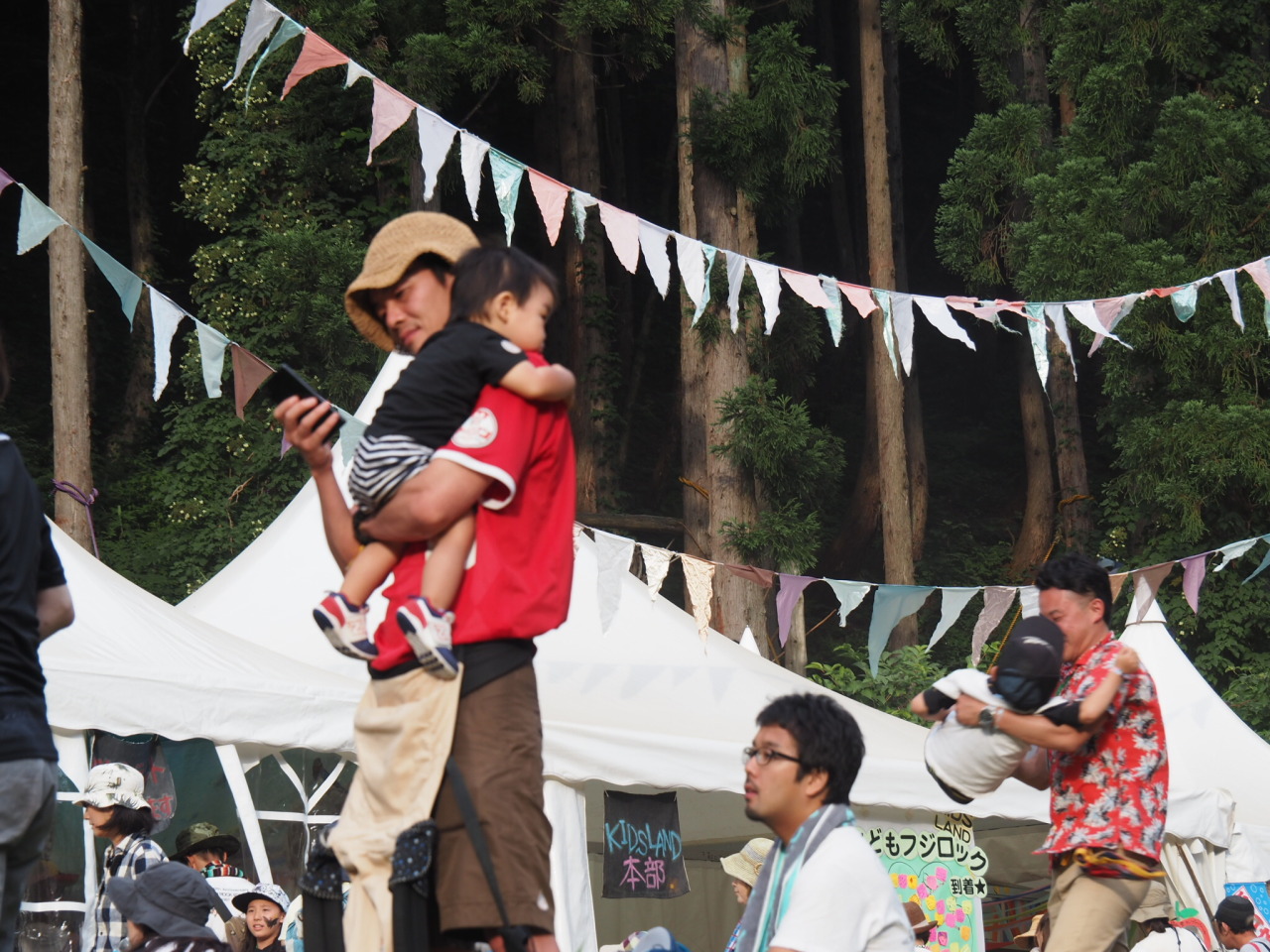
Father’s Day at kids’ land. Rock on mamas! (photo: Mark Thompson)

Zainichi Funk

People will tell you that the Japanese can’t do funky. Obviously, that’s a stereotype that’s been around too long. At the very least, Japanese are no less funky than white people, which may not be saying much, but if you hear someone say “Japanese folk just ain’t got the funk!”, play them some Zainichi Funk.

image

“Zainichi” means “resident in Japan, and Zainichi Funk’s music takes Japanese themes and motifs and funkifies them. Understanding the above–mentioned prejudice, however, they have fun with the concept. Leader Kenta Hamano, for instance, has all the JB moves down, but he doesn’t make any sort of claim to doing them well. His splits and dance steps are more like JL (Jerry Lewis) than JB, but he also adds stuff that’s completely his own, like this stuttery thing on tip toes. And while his singing isn’t going to give Bobby Byrd anything to worry about, he commands a charming vibrato that adds a bit of sassiness to his delivery. And we love his strawberry sherbet suit. He also does his patter in purposely bad English. "So, you wanna call and response?” he yelled. “Let’s call-and-response.” He then gave the audience an almost impossible tongue twister.

image

Jokes aside, though, the band is tough. During their afternoon set on the White Stage they sampled every brand of funk, from JB’s “Super Bad,” to funkified versions of kayokyoku (traditional Japanese pop). One song, a smooth R&B jamm called “Kyoto” trotted out all the Japanese streotypes in another call-and-response gambit. “Pokemon,” “Nintendo,” “ninja,” etc. The audience loved it at by the end of the 45-minute set the crowd had overflowed the borders of the venue. They know who’s got the funk. (text: Philip Brasor; photos: Mark Thompson)

image

Vant

The one problem with not having any rain is that the festival grounds get really dry and dusty. We woke up this morning coughing like Philip Marlowe, and when we blew our nose, it was practically black.

Speaking of snotty, Vant, the 4-piece group from “planet earth,” roused the crowd at the White Stage from their lunchtime doldrums with a smart set of short, fast, loud songs that combined the power chord popistry of classic grunge and the lighter side of the pre-millennial punk revival. Though the band is actually from London, leader Mattie Vant sings like a bratty American, which, combined with the refreshingly cutting political bent of his writing, makes you think he went to high school in Berkeley. 

image

Still, the flannel shirt on such a day was bit much, and we were immensely relieved when he took it off after the third song. An antic performer and a cleverly economical hard rock guitarist, Vant doesn’t mince words. “Stop living in fear,” went one chorus, “and put down your gun.” Another one simply stated, “I don’t believe in God." 

image

The ecumenical flavor of the lyrics matched his stage demeanor, which tended toward hyperbole. "This is the most beautiful place we’ve ever played,” he said, staring up at the trees, “but it’s not just the view. It’s the company, too.” Awww, shucks. At the end of the blistering 45-minute set, the crowd had doubled in size and Vant was inspired toward more love. “This is the best show we’ve ever played.” (text: Philip Brasor; photos: Mark Thompson)

image

Mark Ernestus’ Ndagga Rhythm Force

Since we’re not familiar with electronic artist Mark Ernestus, we’re not sure exactly why his name is attached to the African group, since he was nowhere to be seen during the Field of Heaven performance at noon on Saturday. It hardly mattered. Though the group has a guitarist and a keyboard player, per their name, this is all about rhythm in all its glorious complexity.

image

The sun was beating down, and quite a few of the people who gathered looked as if they had had long nights. But as the band came out, one by one, and kept adding to the deceptively simple pattern launched by the kit drummer, everything fell into place, and by the time the vocalist arrived to get everyone clapping and dancing, they already were.

image

Then a dancer with preternaturally supple limbs came out gyrating wildly and throwing candy to the audience. The interaction was complete, because this wasn’t just a bunch of musicians playing for a crowd. Everything and everybody was connected, and while we don’t think it was completely improvised it looked, sounded, and tasted like total spontaneity. The talking drum spoke volumes as one of the drummers and the dancer put on a contest that ended in a wrestling match. Drummers changed places with other drummers without dropping the beat. The singer chanted and laughed and kept the audience in the loop. It was already hot, and just kept getting hotter. (text: Philip Brasor; photos: Mark Thompson)

image

Disclosure

We were a little late to the Disclosure show at the White Stage and by the time we arrived the party was going full blast, the area one would normally call the mosh pit a churning mass of humanity. 

image

It was just the Lawrence brothers on stage, sans high-profile vocalists, who were represented by recordings, so most of the action was in the audience. Disclosure’s frantic, bass-heavy, poppy dubstep almost never lets up, but the crowd didn’t seem to require a break, at least not while we were watching. When they launched into “Carnival,” you could finally understand the title. It was a song made for this kind of huge, unhinged crowd.

image

In the end, vocalists would just have been an unnecessary distraction. It was certainly the biggest dance party we’d seen at the White Stage in a long time. We’re tired just thinking about it. (text: Philip Brasor; photos: Mark Thompson)
Sigur Ros

Obviously, no one came to headliner Sigur Ros’s show on Friday night to dance. Still, there was quite a bit of spectacle. It took the Icelandic group’s large crew more than an hour to set up their stage set. It was as they were building a house. When the band took the stage they were only half visible, because the front of the structure had a kind of louvered surface with tons of LEDs. It was as if you were watching them play behind a sparkling venetian blind. 

image

Over the course of their show this structure gradually fell away, though we couldn’t tell you how, but eventually they were exposed for all to see, sawing away at their instruments and keening in that uniquely wild fashion. The visuals didn’t stop with the set, though. 

image

The giant monitors on the sides of the stage showed images of the band that had been radically processed–something they looked like skeletons, other times like ghosts, which simply added to the group’s somewhat self-conscious anonymity. Only the music had character, and whether you like that kind of ethereal psychedelia, it was a real show. (text: Philip Brasor; photos: Mark Thompson)

image

James Blake

Sometimes circumstances conspire to create the perfect show. Though we’ve always been less than enthusiastic about the art of James Blake, the British singer who configures conventional R&B tropes into electronica expressions, we admire him for his earnestness and his ability to convey that earnestness into heartfelt emotion.

image

Circumstances did conspire on Friday night. The weather was partly overcast, but the setting sun made itself known. Moreover, Blake made it clear that regardless of the specific situations of which he sang, he was talking about things everyone could relate to. He thanked the audience in Japanese for showing up and said what an honor it was to play in Japan, as if he’s been asked to perform by the Emperor. But he was sincere, and that sincerity came through in interesting ways. On record you tend to notice the electronic processing, but live everything felt immediate and unfiltered. The lighting was clear and unfussy, and the sentiments were just as comprehensible. We stood on the top of the hill to the left of the stage, listening to those pure feelings for more than an hour and didn’t really want to leave. (text: Philip Brasor; photos: Mark Thompson)

image

Courtney Barnett/The Internet

One thing we noticed about this year’s schedule is that more time seems to have been set aside between acts. We’re not sure as to the reason, since there’s very rarely a problem with someone going on late due to lengthy equipment changes. But one issue that has arisen is that instead of staggering acts on competing stages, often the acts will overlap. That’s only a problem when there are two acts you really want to see playing at the same time. Theoretically, the fans of Australian singer-songwriter Courtney Barnett are probably not the exact same ones for the L.A. neo-soul Odd Future outfit The Internet, but we happen to love both, so there was a quandary.

image

Courtney played first at the Red Marquee at 3:50. Dressed all in black, with a T-shirt inscribed with the words “BAD SEED” on it, she was even looser and more confident than when we saw her last October at a club in Tokyo. The shed was totally packed, despite the fine weather outside, and the response was warm and enthusiastic. Unfortunately, Courtney’s presentation, which is sort of sloppy and earnest, sounded like crap in the Red Marquee, which is not kind to loud, sloppy rock due to the acoustics. Since we know most of the songs, we could enjoy it, but you could tell some in the audience who weren’t familiar with her music couldn’t quite get a purchase on the melodies and the guitar work. We left during “Depreston,” one of her mellower tracks, and it actually sounded perfect for that reason.

We booked over to the White Stage to catch the Internet, which took a little longer owing to the crowd that was leaving the Field of Heaven, so we missed the first song. Syd the Kid, resplendent in a dark grey hoodie, was relaxed and affable, joking with the audience and marvelling at how many people had actually shown up to see them. “This is a big-assed crowd,” keyboardist Matt Martians said, and got everybody to scream at the top of their lungs just because he wanted to see what a big-assed audience sounded like. We suppose that means The Internet doesn’t normally play to big-assed audiences.

image

Syd, for her part, got the crowd to deliver the chorus — “you fucked up” — to the song “Just Say,” and we acquitted ourselves admirably, but the whole set was even looser than Courtney’s and sounded ten times better. Despite the big-assed audience, the group played as if they were in someone’s living room, and Syd’s cool, sexy voice delivered her stories of heartbreak and jealousy with all the anger and passion of Nina Simone. It was a great show by a singer and a band who know how to please because they are obviously difficult to please themselves. (text: Philip Brasor; photos: Mark Thompson)