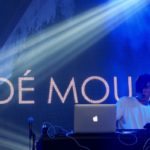
Few pop artists have had to adjust their expectations in accordance with their failures as much as Sampha Sisay, the London native who held forth in the headline position at the Red Marquee on Friday. Having tried and pretty much failed as a hip-hop beatmaker, he ended up remixing others beats (such as The xx’s, who were playing almost at the same time several meters away). But in the end, he just had to put out his own R&B-inflected pop songs, composed on his trusty piano, and set to keyboards and drums.
Though the motif was simple, the presentation was anything but. Sampha, dressed in an odd white getup that looked as if he hadn’t completely put it on, was completely in charge and had the relatively small audience eating out of his hands. Alternately swooning and declarative, his uniquely hushed vocals made such an impression that people around me gasped at the emotional clarity. R&B has turned into a form that favors style over content, but Sampha doesn’t see much distinction. (Text: Philip Brasor; photos: Mark Thompson)
The xx were fairly humble during their amazing early evening gig on the Green Stage. Only the three of them, performing intensely emotional music with beats that penetrated to the core, and the overcapacity crowd felt every intention. Though Romy Croft and Oliver Sim fronted the band with their vocals and warm stage patter, it was Jamie xx Smith who commanded the show, perched atop his riser in the back with his battery of keyboards setting the beats and, for that matter, the general tenor of the show. The xx’s peculiar brand of white bread R&B is founded on a distinctly downtempo model, and yet the hour-long show cooked and simmered thanks to Jamie’s instinctive gift for finding the kernel of a surefire melody in his search for the perfect riff.
It was one of those nights of perfect synergy. Smash has occasionally, but not always, been able to program their Fuji Rock stages so that the acts complement one another.
The xx’s show flowed perfectly into that of the Gorillaz, a band that most people think exists only on digital media. The cartoon characters that front the group, however, remained in the background, on the back screen.
Though Damon Albarn and his backup band donned black surgical masks for the first song, it was mostly a feint. They discarded them and launched into a full blown band concert that never flagged. At one point, Albarn acknowledged that the band’s anime m.o. may have held it back as a live act. This was their second time in Japan, but the first time “at an industrial setting” in 2001 (Summer Sonic, to be exact), where the band played behind a scrim, was apparently less than ideal.
Albarn made up for it with a funk marathon that stretched his understanding of black music, and while he had to rely on various black rappers and singers to fulfill his ideas, it was for the most part Albarn’s show all the way, and he held his own. It may have been the most viscerally satisfying show we’ve seen on the Green Stage since Rage Against the Machine back in 99, and that’s saying a lot. The thing is, Gorillaz knows what it takes to rock a crowd of over 10,000 people. It’s a rare talent.
We’ve already talked about how specifically Japanese acts may not connect in the way they’ve intended to foreign punters at the festival. However, Father John Misty’s early evening performance at the Field of Heaven demonstrates pretty much the opposite: How an artist flies over the head of the local audience and talks directly to those who understand where he’s coming from.
This particular truth was illustrated abruptly after the fourth song of the set. Misty apologized for all the “American and English” fans in the audience who were screaming out favorites and generally making a nuisance of themselves. “Silence make us very nervous,” he said, in deference to the Japanese audience’s…deference.
He had a point but also missed it. What’s mainly prominent in Misty’s show is the dramatic, performative element that becomes the kernel of his point. Basically, Misty is Kenny Loggins trapped in the body of an r&b sex god, and Misty exaggerated this quallity to such a degress that the Japanese fans in the audience could only look on in awed bewilderment, but the gaijin knew exactly what he was talking about when he sexualized the forest background and talked about getting it on with his significant other in a tent on the edge of Fuji Rock. It was perfect: He was localizing his musical sensibility, but, unfortunately, only the foreigners understood what he was getting at.
But drama always succeeds. The best joke in Misty’s arsenal is the fact that his band looke like variations of him: besuited, hirsute, white to the point of embarrasment. And while his sexual component is obviously a ruse, it’s also effective. During one song, I noticed two Caucasian women dancing with each other in sexual abandon and mouthing the lyrics to the song. That’s attraction.
And then there was “Honey Bear,” the epitome of his psycho-sexual ouevre, a song that he sang as if he were James Brown, kneeling and pleading with his love for her sexual favors, and even the Japanese caught on to the story. Though the crowd was relatively small, the reaction was nuclear. People erupted, they spent themselves.
Jonathon Ng, the Irish singer-songwriter better known as Eden, was fifteen minutes late to his Red Marquee show, and then technical glitches delayed his first number by another five. It wasn’t an auspicious start, and so it was with some surprise that we noticed the place filling up quickly as his second song ended. The guy’s dark, one-man emo-flavored electronica has a certain morbid appeal, but we didn’t think it was magnetic. And then we realized: It was raining. Pretty hard, too. Which means Eden was one of those chosen few blessed by what we like to call the “wet bonanza”: an automatic full house because people are getting in out of the downpour. As with most people who are visited by this blessing, he didn’t notice it—or, if he did, he didn’t acknowledge it, and, in fact, seemed pretty stoked by the size of the crowd. All his trespasses were forgiven.
Consequently, it took us a while to get out of the Marquee, what with all the bodies, and we wanted to get over to the Green Stage to see the Route 17 Rock and Roll Orchestra, a collection of studio and touring vets who have played Fuji before, usually in a revue style. Today, in the middle of a rainstorm they were featuring four big guest stars, and, miraculously, as soon as the first one, Tortoise Matsumoto, lead singer of Ulfuls, came out in a snazzy maroon suit, the rain stopped. We were thankful for that, not the suit or, for that matter, his earnest versions of American soul music, but the fact that he stopped the rain.
It was guaranteed kitsch, with a trio of dancing girls/backup singers dressed in colorful lame gowns. When Matsumoto was finished, veteran guitarist Chabo Nikaido came out and did some standard rock-type songs. Even since his former musical partner, Kiyoshiro, died he’s been trying to get his job as the unofficial mayor of Fuji Rock, and so he did a nice version of Kiyoshiro’s biggest hit, “Daydream Believer” (Yes, the Monkees song). The girl singers then did their version of “Please Mr. Postman,” punctuated by an appearance by Jason Mayall as the titular mail carrier. To lend the festivities the proper entertainment gravitas, DJ Chris Peppler came out to introduce Elvin Bishop, who looked as if he’d just rolled out of bed. He did a few blues and his one hit, “Fooled Around and Fell in Love,” which was sung by the black guy in an Oakland Athletics shirt who did a pretty amazing imitation of Mickey Thomas and was the best thing about the whole set. It wasn’t until he left the stage that we learned his name: Willie Jordan.
But the big name of the afternoon was the “wakadaisho” (young general) himself, Yuzo Kayama, who’s pushing 80. Kayama was one of the biggest movie stars of the 60s, but before he was an actor he was known as a guitarist in the Ventures digga-digga-digga-DON mode. He came out and played two instrumentals to prove he can still shred. He then did a passable version of a very good Elvis Presley song, “Blue Moon,” and then his big hit, whose title we can never remember, but it had the hold crowd waving and sniffling. Kayama couldn’t hide his age—his speaking voice is frailer than I remember it from TV—but he still looks good and thinks the kids are all right.
For the big finish, everyone returned to the stage for a version of “Johhny B. Goode” in tribute to Chuck Berry, who died earlier this year. It was obviously a rush job: Chris Peppler contributed a verse but had to read lyrics off his wrist. Even Bishop seemed to be watching the Route 17 guitarist for the changes—doesn’t everybody know the chords to “Johnny B. Goode”? But it all ended on an up note, and it didn’t rain a drop.
Forecasts to the contrary, the opening day of Fuji Rock 17 was hot and overcast. There was a sprinkling of rain around 11 a.m., but then the sun came out, sending everyone prematurely to the tents for beer and water and sports drinks. Some things never change.
But one subtle change that was noted several weeks ago by Patrick St. Michel in the Japan Times was notable: the preponderence of Japanese acts at this year’s festival (and, for that matter, at Fuji’s rival, Summer Sonic, as well). There are a number of good reasons why there should be a preponderence of Japanese acts at Fuji, the most prominent being that we are in Japan, goddammit, and there are a lot of great bands here. Except for the Spanich hybrid rock outfit, Doctor Prats, who wowed ‘em at the Red Marquee last night and launched the White Stage this morning, the opening acts on all the stages were locals.
We caught some of Yogee New Waves’ disco surf pop at the Field of Heaven before bolting for the Green Stage to see Group Tamashii, a band whose presence as the main opening act sums up this presumed turn to domestic product rather starkly. Fuji Rock is a huge draw for foreigners, and not just those who live in Japan. Last night we met several groups of Asians who had flown in to spend the whole weekend, many with their families in tow. Though Group Tamashii is a rocking good show, they’re also Japanese to the extreme. Actually, they’re a comedy group, and you know what they say about how humor translates…
Dressed ostentatiously in leather, the group has pretty much one theme: Sex, and not sex as an enjoyable pastime or a seminal aspect of living, but as a joke. Moreover, a dirty joke. Lead singer Hakai, who occasionally bombarded the audience with cheap plastic slippers he flung like frisbees, kept up a steady stream of blue language—he didn’t even bother with double entendres—that left the Japanese chuckling and the rest of us scratching our heads.
It’s not that we don’t understand sex jokes when we hear them—at one point, the portly backup singer Baito-kun came out dressed as a school girl and Hakai said, “Your clitoris is showing”—but these gags were soaked in Japanese pop culture, referencing names and situations that only Japanese people would be familiar with. (There was a five-minute routine about Kabuki guild names that had the Japanese in stitches) Given that Fuji prides itself on being a family-friendly event, one had to wonder what some of the Japanese parents thought.
Prurience aside, Group Tamashii is a nifty, tight little outfit, slaloming smoothly from thrash metal to punk to a disco song about sushi and a pretty faithful Michael Jackson parody. Actually, the foreigners who don’t know any Japanese and anything about Japanese pop culture probably got the better deal: It was a nice way to rock in the weekend.
We pulled into Naeba through the tunnel expecting rain, since that’s what was forecast. Instead, we were met with overcast skies studded with patches of blue. A pleasant surprise, for sure, though, given the serendipity of nature, I wouldn’t want to venture on how long that will last.
As usual, the prefestival party, open to all for free, was packed. The Bon Odori event in the middle of the Oasis rocked the crowd, who didn’t seem that interested in the lottery (ticket stub numbers) that was conceived to make people interested. People were already interested. Fuji Rock is interesting by definition.
It’s mostly a matter of anticipation. Three days of nonstop partying and excellent music ahead of them, the crowd that shows up for the prefestival party wants to get ahead of everybody else. They probably expect too much. They probably laugh too much. They definitely drink too much. When the fireworks marking the official start of the festival take off at 8 pm, they go batshit (which isn’t surprising–the Japanese do fireworks better than anyone), thus making the spectacle that much more spectacular.
And, of course, they anticipate that prefest act that will transport them, which is natural to expect. Tonight there were various Japanese acts, all excellent and appreciated, but the main event was Doctor Prats, a Basque dance rock ensemble that fit the bill to a T.
Loyal Fujirock lieutenant Koichi Hanafusa came out before the band took the Red Marquee stage and gave a rather long-winded introduction, saying how the prefest party had become such a tradition that it had been memorialized in a book, no less, and then, of course, he had a photographer take a picture of the crowd, which was enormous and chomping at the bit. He introduced the band as being in the tradition of “revolutionary” Basque groups like Furgin Mugurizuka and Manu Chao, and in that regard Doctor Prats did not disappoint. For the next 30 minutes the crowd jumped and pumped to the organic breakbeats and clever stage choreography. They did exactly as they were supposed to do. They were the perfect audience, because they wanted to be. Undoubtedly, it was the best show Doctor Prats had ever done in their career so far. The prefest party guaranteed nothing less.
We were quite happy to see that the organizers revived the post-headliner party at the Green Stage on Sunday night. This year they asked those electronica pranksters Denki Groove to provide the music, perhaps as a nod to the fact that the group is celebrating their 25th year in show business, and they were perfect.
Sporting one of his famous top hats, Pierre Taki held the stage and the audience’s attention while partner Takkyu Ishino manned the boards, though he had a lot to add, vocally, to the performance. Of course, they played “Shangri-La” and all the hits, though at this point “hits” is a relative term for a group whose stage strategy is to be as spontaneous and in-the-moment as possible.
We were sort of wandering around, marveling at the variety of dancing that was going on. It was as if everyone had received a second (third?) wind that would blow them into the next week. First they have to make it to morning. (text: Philip Brasor; photos: Mark Thompson)